Othello
Shakespeare's 'Othello' is a masterclass in psychological manipulation, exploring how jealousy, racial prejudice, and deception can destroy even the most noble of characters. It is highly rewarding to study because of its intense focus on a single villain's orchestration of chaos, offering rich opportunities to analyse dramatic irony, shifting settings, and the devastating power of language.
Study Notes
Overview
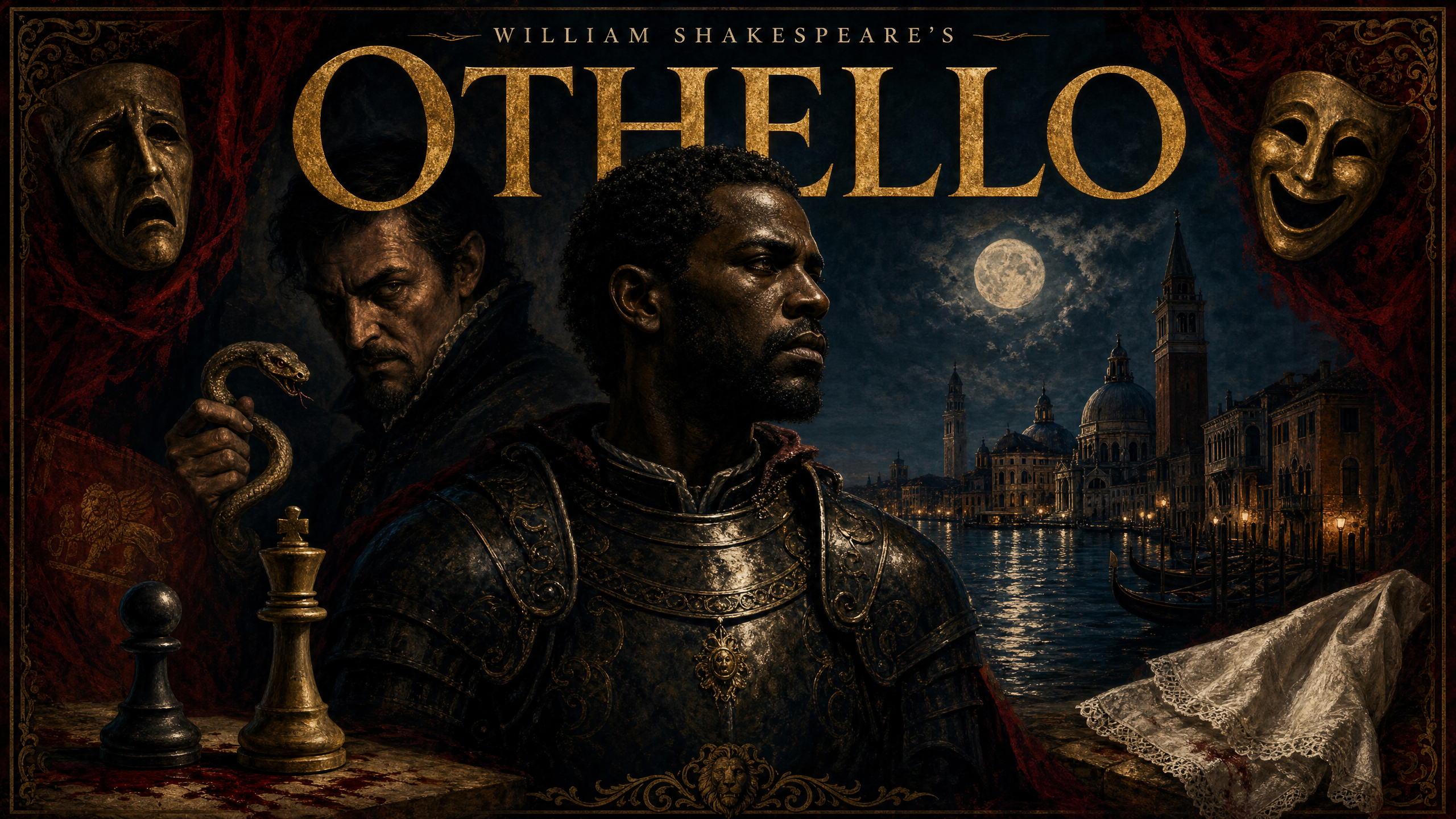
'Othello' is one of Shakespeare's most intense and claustrophobic tragedies. Set against the backdrop of the Venetian-Ottoman conflict, the play traces the tragic downfall of Othello, a noble Moorish general in the Venetian army, who is systematically destroyed by his trusted ensign, Iago. Examiners look for candidates who can move beyond plot summary to analyse how Shakespeare constructs this tragedy. This means exploring the structural shift from the order of Venice to the chaos of Cyprus, analysing the precise linguistic methods Iago uses to manipulate Othello, and understanding how Othello's race is central to the play's exploration of identity and prejudice. The highest marks are awarded to those who can seamlessly weave contextual understanding—such as Elizabethan attitudes towards race and gender—into their analysis of Shakespeare's methods.
Listen to our comprehensive revision podcast for a deep dive into these concepts:
Plot/Content Overview
- Act 1: Venice: Iago and Roderigo awaken Brabantio to tell him his daughter, Desdemona, has eloped with Othello. Othello defends his marriage before the Venetian Senate, eloquently explaining how they fell in love. The Senate orders Othello to Cyprus to defend against a Turkish fleet.
- Act 2: Arrival in Cyprus: A storm destroys the Turkish fleet, meaning the external threat is gone, but the internal threat (Iago) begins. Iago gets Cassio drunk, causing a brawl. Othello strips Cassio of his lieutenancy. Iago advises Cassio to ask Desdemona to plead his case to Othello.
- Act 3: The Temptation: In the pivotal Act 3 Scene 3, Iago plants seeds of doubt in Othello's mind about Desdemona and Cassio. Desdemona drops her handkerchief; Emilia gives it to Iago. Othello demands "ocular proof," and Iago uses the handkerchief as evidence. Othello vows to kill Desdemona.
- Act 4: The Descent: Othello's jealousy consumes him. He falls into a trance, publicly strikes Desdemona, and treats her as a whore. Iago manipulates Roderigo into agreeing to kill Cassio.
- Act 5: The Tragic Climax: Roderigo fails to kill Cassio and is killed by Iago. Othello murders Desdemona in her bed. Emilia exposes Iago's plot, revealing the truth about the handkerchief. Iago kills Emilia. Realising his terrible error, Othello delivers a final speech and kills himself. Iago is arrested but refuses to speak.
Themes
Theme 1: Jealousy
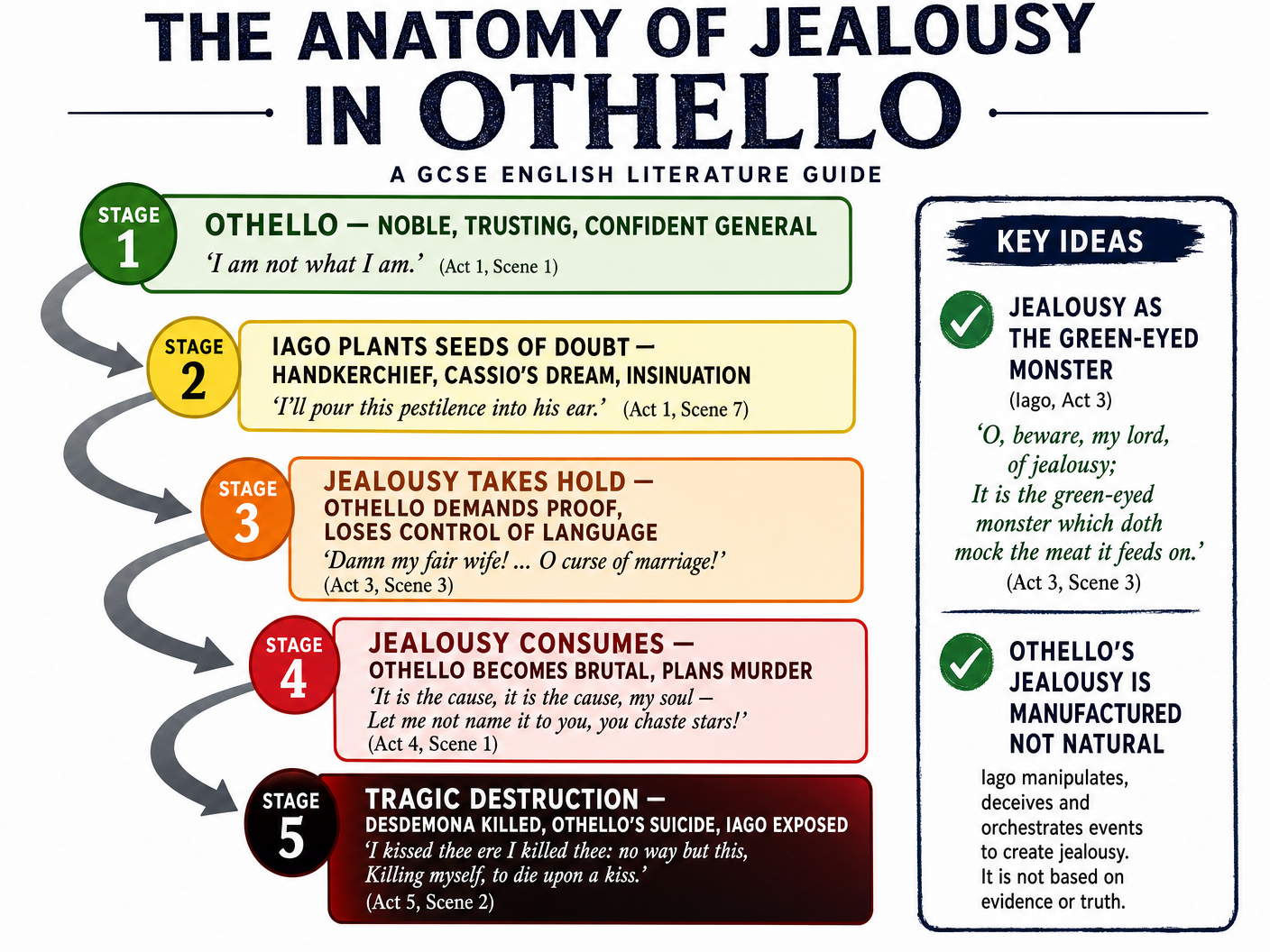
Jealousy is the destructive engine of the play. However, it is crucial to recognise that Othello's jealousy is manufactured by Iago rather than being an inherent flaw. Shakespeare explores how jealousy distorts perception and destroys language. As jealousy takes hold, Othello's elevated, poetic language degrades into fragmented, violent prose, mirroring his psychological collapse.
Key Quotes:
- "O, beware, my lord, of jealousy! / It is the green-eyed monster which doth mock / The meat it feeds on." (Act 3, Scene 3) - Iago's warning is deeply ironic. The metaphor of the "monster" suggests something unnatural and consuming.
- "Trifles light as air / Are to the jealous confirmations strong / As proofs of holy writ." (Act 3, Scene 3) - Iago explains how jealousy warps reality, making a simple handkerchief seem like absolute proof of infidelity.
Theme 2: Manipulation and Deception
Iago is a master manipulator who operates by exploiting the weaknesses of others. He uses insinuation and half-truths, allowing Othello's imagination to do the destructive work. The theme highlights the vulnerability of trust and the terrifying power of language when used maliciously.
Key Quotes:
- "I am not what I am." (Act 1, Scene 1) - Iago's paradoxical statement to Roderigo establishes his deceptive nature from the outset, subverting the biblical "I am that I am."
- "I'll pour this pestilence into his ear" (Act 2, Scene 3) - Iago's metaphor reveals his method: his words are a poison that will infect Othello's mind.
Theme 3: Race and Otherness
Othello's status as a Black man in a white society is central to the tragedy. While he is respected for his military prowess, he is simultaneously subjected to racist language and suspicion. The play explores how societal prejudice can be internalised; Othello ultimately begins to view himself through the racist lens of his detractors.
Key Quotes:
- "Even now, now, very now, an old black ram / Is tupping your white ewe." (Act 1, Scene 1) - Iago uses crude, animalistic imagery and racial contrast to incite Brabantio's anger.
- "Haply, for I am black / And have not those soft parts of conversation / That chamberers have" (Act 3, Scene 3) - Othello internalises the racist attitudes of Venice, doubting his own worth and blaming his race for Desdemona's supposed infidelity.
Character Analysis
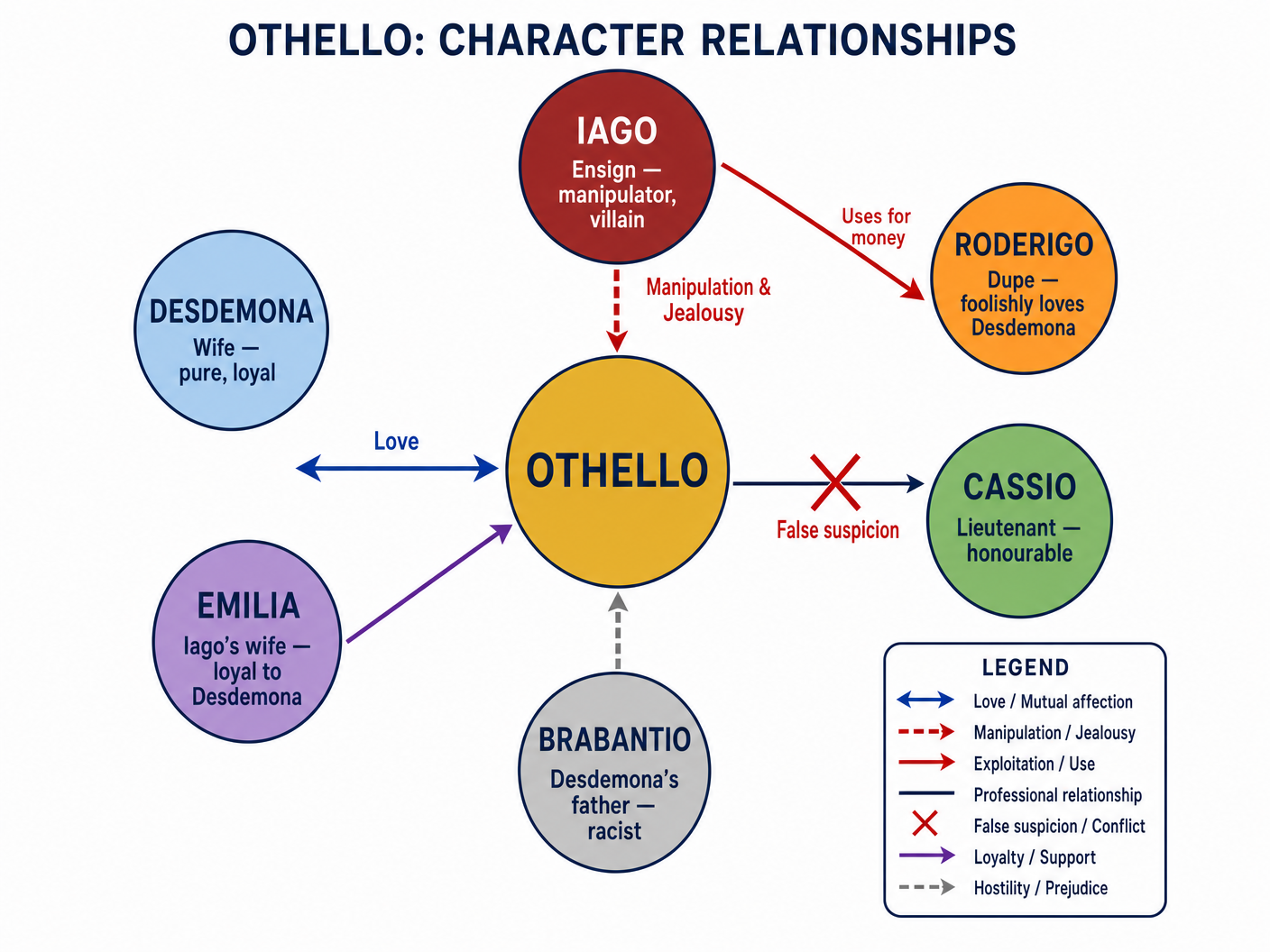
Othello
Role: The tragic hero; a noble Moorish general whose trusting nature is exploited.
Key Traits: Noble, eloquent, insecure, passionate, ultimately violent.
Character Arc: Moves from a confident, rational commander in Venice to an irrational, jealous murderer in Cyprus, before achieving a moment of tragic self-awareness before his death.
Essential Quotes:
- "She loved me for the dangers I had passed, / And I loved her that she did pity them." (Act 1, Scene 3)
- "Farewell the tranquil mind! farewell content! / Farewell the plumed troop... Othello's occupation's gone!" (Act 3, Scene 3)
- "Then must you speak / Of one that loved not wisely but too well;" (Act 5, Scene 2)
Iago
Role: The antagonist and Machiavellian villain.
Key Traits: Manipulative, cynical, perceptive, amoral, deceptive.
Character Arc: He remains consistently evil, successfully orchestrating the downfall of almost everyone around him, though his own motives remain ambiguous ("motiveless malignity").
Essential Quotes:
- "Demand me nothing: what you know, you know: / From this time forth I never will speak word." (Act 5, Scene 2)
- "Thus do I ever make my fool my purse" (Act 1, Scene 3)
Desdemona
Role: The tragic victim; Othello's loyal wife.
Key Traits: Pure, loyal, initially assertive, ultimately submissive to patriarchal power.
Character Arc: Begins as a confident woman who defies her father and the Senate to marry Othello, but is increasingly silenced and victimised as Othello's jealousy grows.
Essential Quotes:
- "I do perceive here a divided duty:" (Act 1, Scene 3)
- "Nobody; I myself. Farewell. / Commend me to my kind lord: O, farewell!" (Act 5, Scene 2)
Writer's Methods
- Dramatic Irony: Shakespeare extensively uses dramatic irony, primarily through Iago's soliloquies. The audience knows Iago's plans while the other characters trust "honest Iago." This creates intense tension and implicates the audience in his plotting.
- Setting as Structure: The shift from Venice to Cyprus is structural. Venice represents law, order, and reason. Cyprus, a military outpost on the edge of the Venetian empire, represents isolation, chaos, and the unleashing of passion. When the external threat (the Turks) is removed, the internal threat (Iago) flourishes.
- Language and Verse: Othello initially speaks in measured, poetic blank verse (iambic pentameter), reflecting his nobility and control. As he descends into jealousy, his language breaks down into fragmented prose, oaths, and animalistic imagery, mirroring his loss of rational control.
- Symbolism: The handkerchief is the central symbol. To Othello, it represents love and fidelity; to Iago, it is a tool for manipulation; to Desdemona, it is a cherished token. Its loss symbolises the loss of trust and the destruction of the marriage.
Context
Examiners expect candidates to integrate context (AO3) seamlessly into their analysis. Key contextual areas include:
- Elizabethan Attitudes to Race: The term "Moor" was used loosely to describe people of North African or Middle Eastern descent. Blackness was often stereotypically associated with savagery, hypersexuality, and the devil. Shakespeare plays with these prejudices, initially presenting Othello as noble, but showing how easily a society can revert to racist assumptions.
- Patriarchy and the Role of Women: In Renaissance society, women were legally the property of their fathers and then their husbands. Desdemona's initial defiance of Brabantio is highly transgressive. Her tragic end reflects the vulnerability of women in a patriarchal society where male honour and reputation were paramount.
- The Setting: Venice was known for its wealth, sophistication, and strict laws, but also for its courtesans. This dual reputation feeds Othello's insecurities when Iago suggests that Venetian women are inherently deceptive.
- The Tragic Form: The play follows Aristotelian tragic conventions: a noble protagonist with a fatal flaw (hamartia) makes an error in judgement leading to a reversal of fortune (peripeteia) and an inevitable, catastrophic conclusion.
Visual Resources
2 diagrams and illustrations
Interactive Diagrams
1 interactive diagram to visualise key concepts
Conceptual Flow Outline
Othello's Tragic Arc and Structural Shifts
Worked Examples
2 detailed examples with solutions and examiner commentary
Practice Questions
Test your understanding — click to reveal model answers
Starting with this extract (Act 1 Scene 3, Othello's speech to the Senate), explore how Shakespeare presents Othello as a noble character. Write about the extract and the play as a whole.
Hint: Look at Othello's measured blank verse in the extract. Contrast this with how his nobility is destroyed by Iago later in the play.
Explore the significance of the setting in Shakespeare's 'Othello'.
Hint: Think about the structural contrast between Venice (law, order, civilization) and Cyprus (war, isolation, passion).
How does Shakespeare present the relationship between men and women in 'Othello'?
Hint: Consider the different experiences of Desdemona, Emilia, and Bianca, and how male insecurity drives the tragedy.
Explore how Shakespeare presents the theme of deception in 'Othello'.
Hint: Focus on Iago, but also consider how other characters deceive themselves.